Uses for a digicam, #2378 [entries|reading|network|archive]
simont

[ userinfo | dreamwidth userinfo ]
[ archive | journal archive ]

Fri 2008-02-01 12:06
Uses for a digicam, #2378

I recently replaced the seven 50W GU10 halogen spotlights in my kitchen light fitting with 7W energy-saving bulbs, after managing to google up some which weren't 2cm longer than the originals and hence actually fitted into the space.

The new bulbs take a few minutes to come on fully. I wondered how long, because that way I know how long to go away and wait after flicking the switch. Unfortunately, finding that out by sitting and watching is a bit tricky, because one's attention wanders and in any case one's eyes adjust constantly so it's hard to say whether the lights are still getting gradually brighter or have stabilised.

Solution: the digital camera to which I treated myself at Christmas, in video recording mode. Set it up on a tripod pointing at the kitchen door, with a bit of uniformly lit dining room wall in shot as well to compare against; start it recording; turn kitchen lights on; go away and leave it until it runs out of disk space. Extract the resulting video file, convert into a gigabyte of PNGs, and analyse them in software.

So now I have a nice graph plotting light level against time:

from which I can read off the time to absolute peak brightness as (as closely as I can get by zooming in) 3 minutes and about 39 seconds. Of course, it'll be usably bright long before then, if I'm impatient to eat; but for some things (such as washing up, where I've found bright light really helps for noticing things aren't properly clean) I think I actually would want to make sure I had full brightness.

The glitch at the start of the graph is because I had to actually walk in front of the camera to flick the switch, skewing the average brightness of the picture while I was in shot. Unfortunate but necessary, in the absence of a cloak of invisibility.

An excessive effort, perhaps, but it was fun. Also it vaguely justified the new camera, since the old one's video recording capabilities wouldn't have been nearly up to this job. (That is, even before I broke it beyond repair.)

LinkReply
[personal profile] zotzFri 2008-02-01 12:44
So who made these ones?

My experience of fluorescent bulbs is they vary quite a bit. The Ikea ones I have take a while to warm up, but the General Electrics don't (and are no more expensive and available from Woolworths down the road).
Link Reply to this | Thread
[identity profile] olithered.livejournal.comFri 2008-02-01 13:07
Indeed there is a world of difference. We've had excellent results from philips (at £1 each) bought last year, especially in comparison to older ones...
Link Reply to this | Parent
[personal profile] simontFri 2008-02-01 13:17
They're these; the website doesn't state the brand, but when I received them they each said "Pro-Lite" on the box.
Link Reply to this | Parent
[identity profile] ptc24.livejournal.comFri 2008-02-01 16:15
I'm surprised the camera isn't adjusting constantly too...
Link Reply to this | Thread
[personal profile] simontFri 2008-02-01 16:21
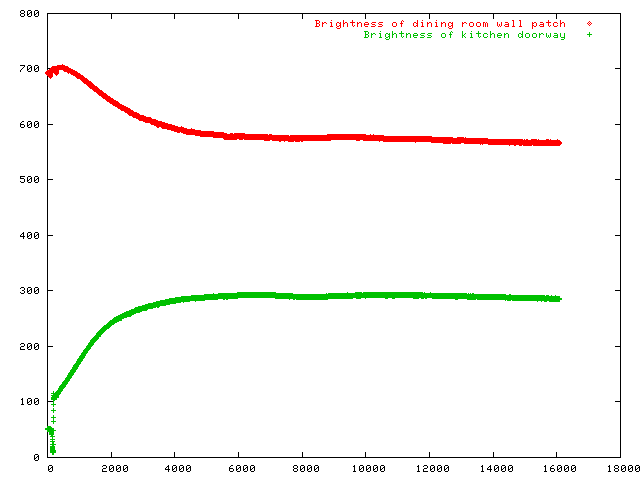
It was. What you see there is the average brightness in a rectangle of image contained entirely within the kitchen doorway, divided by the average brightness in a rectangle of image contained entirely within the dining room wall (which I assumed to have constant real brightness). If I plot the two separately, it's clear that the camera is indeed adjusting, because the brightness of the DR wall goes a bit down as the brightness in the kitchen goes up.
Link Reply to this | Parent | Thread
[identity profile] ptc24.livejournal.comFri 2008-02-01 16:57
Oh yes, score FAIL for my reading comprehension.

It would be interesting to see the two separate graphs of the unadjusted average brightnesses in your two rectangles, to see how the camera adjusts over time.
Link Reply to this | Parent | Thread
[personal profile] simontFri 2008-02-01 17:10
No sooner a word than a whatnot:

(This graph is a bit less processed than the last: it's got the full data set as opposed to just the bit between me hitting the switch around frame 170 and reaching peak brightness at ~7000.)

Link Reply to this | Parent
[identity profile] feanelwa.livejournal.comFri 2008-02-01 18:42
Damnit, why don't you work in our lab? That is exactly the sort of stuff we need to think of all the time.
Link Reply to this | Parent
[identity profile] sunflowerinrain.livejournal.comSat 2008-02-02 10:37
Interesting that different makes take different amounts of time to light up. There are people who object to energy-saving bulbs because of their slowness (presumably having had experience of only the worse kind), and lack of detailed information makes it difficult to convince them that the bulbs really are usable; though there are also people who claim that the bulbs' manufacturing process is more energy-intensive and cancels out the benefit of using them. I don't know how they get that idea.

[livejournal.com profile] feanelwa and I were talking about the need for measures and data to put into the discussion of energy-saving practice (or perhaps I was soapboxing at her...). Your graphs are the kind of thing that Energy21 collects. Unfortunately their site is being changed - http://www.energy21.co.uk/ says the old email is still working.
Link Reply to this
navigation
[ go | Previous Entry | Next Entry ]
[ add | to Memories ]