Reading [entries|reading|network|archive]
simont

[ userinfo | dreamwidth userinfo ]
[ archive | journal archive ]

[syndicated profile] questionable_content_feed Sun 2026-03-15 21:34
Incremental Progress

the second generation Moray units smelled like a Red Lobster dumpster

LinkReply
[syndicated profile] hacker_news_daily_feed Mon 2026-03-16 00:00
Daily Hacker News for 2026-03-15

The 10 highest-rated articles on Hacker News on March 15, 2026 which have not appeared on any previous Hacker News Daily are:

LinkReply
[personal profile] kaberett Sun 2026-03-15 22:37
vital functions

Reading. I continue to work my way through the She's A Beast archives, to a degree that is not necessarily ... uh ... optimal, in terms of all the other things I want to do...

I slowed down on LIFTOFF, on account of resuming reading from the start with A, and then this evening I tripped and fell and am. More. of the way through it. again.

Finished What Is Queer Food? by John Birdsall. Ultimately the argument is that the queerness is a function of community -- the role that food plays in eating together -- though he also tries at various points for "enjoying food is queer" (among other things), which I do not think I am the target audience for. (Having said which I am now wondering what it would take to convince me of that line of reasoning, and Ideas Are Stirring. Hmm.) Overall a mixture of anecdotes from culinary history and fiction to fill in events that went unrecorded; he does hold space for people to be complex and flawed, and I appreciated the history that was actually history, but -- alas, this did not really work for me.

Writing. Words. Continue. To be. Eked out.

Watching. The 2026 Migraine World Summit is ongoing and eating a lot of my time and brain; thus far nothing has made me actually vibrate with fury and I've had a couple of useful joining-the-dots moments, so mustn't grumble there, really. And I have finally watched the talks from last year's Day 2 that I missed due to time changes, and have started transferring my digital notes from last year into my notebook...

Playing. Inkulinati: we continue Not Dead Yet in the Exploders run on Master difficulty.

The Ridiculous Colours Game.

Sudoku... appears to have let go of my brain for now?

Cooking. This evening I have been attempting to remember how to make Spätzle, and got there eventually (part of the difficulty being that this is the first time I've made them since acquiring a dedicated Spätzlebrett, and I needed to reestablish correct consistency of the dough...)

Eating. This morning we engaged in a Weekend Morning Ritual of going down to the local fancy bakery and getting brunch from them. We also got Treats for Afternoon Tea; I am delighted that they'll supply me with cardamom buns that I don't have to actually make myself.

I have also been Craving Brownies, but not enough to actually make them myself (and also The Oven Is Broken), and consequently have eaten them courtesy of both Wagamama (ritual Thursday night takeaway) and London Zoo (Saturday afternoon tea).

Exploring. London Zoo! Saw creatures! Maybe I will even go back and edit in more details about the creatures! Creatures: good.

Several bimbles around local front gardens (etc) to enjoy Spring Flowers.

Growing. Harvested (and consumed!) more salad. Transplanted some garlic. Wrangled some more weeding. Have yet to sow any more things but really want to have Actual Plants this growing season so, uh, maybe that can be a priority for Breaks From Migraine World Summit, not that that's worked so far...

Observing. THE BAT.

And then for brunch this morning we took our breakfast slightly further than usual to a different park bench, this one surrounded by daffodils, and then additionally wandered a little way down the New River (neither new, nor a river) to see if the coots were doing things yet (which I have also been checking every time I go to the pharmacy to pick up meds). The coots aren't, BUT there were TEN EGYPTIAN GOSLINGS peeping about the place!!! At least one of whom was Extremely keen on coming All the way down the bank and plapping along the edge of the bricks, presumably because they were warm and felt nice on feet? Certainly two very gentle attempts to chase it back towards its parents got them contemplating hissing at me, and only persuaded it to maybe do the thing for about thirty seconds at most, so I gave up on that and just stood back and watched them for a bit, and then was very relieved that the foolhardy baby did upon parents Alarm Calling (as best we can tell about A Passing Dog) go FWEEP FWEEP FWEEP all the way back up and into the bundle of its siblings. An unexpected and very welcome delight.

Link4 comments | Reply
[personal profile] andrewducker Sun 2026-03-15 18:54
What books did Terry Pratchett find inspirational?
This is from a post made here on Facebook. I'm copying it here, with the permission of the original author, so that people off Facebook can see it.

I had the pleasure of Terry’s company on a week-long Writer’s Retreat twice, in 1990, as part of a company of eight interesting people in Diss, Suffolk.

Terry later came to my wedding and gave me a proof copy of ‘Lords and Ladies’ as a wedding gift! I had never read his books before I met him, so I began with ‘Wyrd Sisters’ - and have carried on reading them ever since.

When he learned I was meeting up with Terry again, my local Librarian shouted ‘Oook!’ and collected up every book by Terry which he had in the Library, and asked him to sign them. This amused Terry - and shocked other participants! "You shouldn't write in Library Books" etc...

Terry and I were both reading Henry Mayhew’s ‘London labour and the London poor’ at the time.

I asked Terry to make a list of other books which he found inspirational. Here they are:

  • ‘The Evolution Man’ by Roy Lewis.

  • ‘The Specialist’ by Charles Sale.

  • ‘The Canterbury Tales’ by Chaucer.

  • ‘Fairy Tales’ by Charles Perrault.

  • Jacqueline Simpson’s folklore books.

  • Everything by J R R Tolkien and C S Lewis.

  • ‘The Wind From the Sun’ by Arthur C. Clarke.

  • ‘Cold Comfort Farm’ by Stella Gibbons (my favourite book).

  • ‘Mistress Masham’s Repose’ and the Arthurian Trilogy by T H White.

  • I also add the new series of novels set in St Mary’s by Jodi Taylor, of whom I am a keen fan, and strongly recommend. Terry told Jodi how much he liked her writings. Start with ‘Just One Da*ned Thing After Another’ and carry on enjoying!

  • Edit - I forgot 'The Moomins' series!

Link7 comments | Reply
[personal profile] andrewducker Sun 2026-03-15 12:00
Interesting Links for 15-03-2026
Link2 comments | Reply
[personal profile] andrewducker Sun 2026-03-15 08:50
Life with two children: Gideon updates
Following yesterday's illness, I was vaguely hoping that he would stay asleep through the night. Alas:

12:05
"I need a wee"
Took him to the toilet.
"Daddy, my tummy hurts"
Gave him some medicine
"Do you want to be in pyjamas or just straight back to bed?"
"Back to bed"
And then he closed his eyes.

12:20
Thundering footsteps "Daddy, I feel sick"
Told him to go to the toilet. Kept him company, got him a bucket.
He wasn't sick.
Persuaded him to take the bucket to bed.
Sat on the floor next to his bed until he closed his eyes.

12:35
More thundering steps
"Daddy, my arm and leg hurt"
By the time I'd found him medicine he was asleep again.
But woke up again and let me give him some Calpol.

03:30
"I'm hungry" (not surprising as he didn't eat yesterday)
We agreed on cream cheese crackers.
He ate ⅘ of the cracker and drank some juice and passed out again.

06:30
"I checked the light coming under the curtain and it's morning time"
I told him to go play games on the Switch downstairs.
Fifteen minutes later I could still hear him wandering about and I hadn't heard any game noises.
Went to check on him and he told him that he'd found various points around the house where the floor isn't flat.
Got him settled with the Switch, and then went back to bed and stared vacantly at my phone for an hour, before getting up to face the day.
Link14 comments | Reply
[syndicated profile] hacker_news_daily_feed Sun 2026-03-15 00:00
Daily Hacker News for 2026-03-14

The 10 highest-rated articles on Hacker News on March 14, 2026 which have not appeared on any previous Hacker News Daily are:

LinkReply
[personal profile] kaberett Sat 2026-03-14 22:49
zoo!

highlights included:

otherwise everything is still Migraine World Summit (though I have once again learned a useful thing today! neck pain can be a prodrome symptom!) and Special Interest.

Link1 comment | Reply
[staff profile] mark on [site community profile] dw_maintenance Sat 2026-03-14 13:04
Performing some traffic maintenance today

Happy Saturday!

I'm going to be doing a little maintenance today. It will likely cause a tiny interruption of service (specifically for www.dreamwidth.org) on the order of 2-3 minutes while some settings propagate. If you're on a journal page, that should still work throughout!

If it doesn't work, the rollback plan is pretty quick, I'm just toggling a setting on how traffic gets to the site. I'll update this post if something goes wrong, but don't anticipate any interruption to be longer than 10 minutes even in a rollback situation.

Link19 comments | Reply
[personal profile] fanf Sat 2026-03-14 18:54
poached eggs

https://dotat.at/@/2026-03-14-eggs.html

A few weeks ago I was enjoying a couple of boiled eggs

(in the shell, with plenty of salt and pepper, and buttery fingers of toast to dunk into the runny yolk)

and pondering how fiddly it is to cut off one end of the shell after boiling compared to eating a poached egg. And I was annoyed because (I thought) I didn't know how to poach eggs.

Read more... )

Link3 comments | Reply
[personal profile] andrewducker Sat 2026-03-14 12:33
Photo cross-post


The first time Gideon fell asleep in front of the toilet we moved him to a comfy chair. From where he woke up still feeling sick and Jane found him lying on the floor with a bucket he'd found and relocated him back to the toilet, where he then fell asleep again.

I missed all of this because I had passed out in bed feeling rubbish. I did wake up to various noises, but each time I did I tried to open my eyelids, failed, and fell back to sleep again. Thankfully Jane isn't feeling as bad as me, and Sophia was off having a play date at the other end of the street.

So far nobody has actually thrown up. Fingers crossed that continues.
Original is here on Pixelfed.scot.

Link6 comments | Reply
[syndicated profile] schneier_no_tracking_feed Sat 2026-03-14 16:02
Upcoming Speaking Engagements

Posted by B. Schneier

This is a current list of where and when I am scheduled to speak:

The list is maintained on this page.

LinkReply
[personal profile] andrewducker Sat 2026-03-14 12:00
Interesting Links for 14-03-2026
Link6 comments | Reply
[personal profile] rmc28 Sat 2026-03-14 02:29
Hockey hockey hockey

I hadn't been on the ice since last Saturday (Huskies and Women's Blues practices were all Varsity squads only, and Kodiaks practice got cancelled by the rink) but I made it to and through Warbirds practice tonight. It was so worth it. I also got my Varsity notebook from Women's Blues: every team member gets a notebook, and everyone writes a note in every teammate's notebook, and we read them before Varsity to inspire us. Mine was very sweet and I love the team very much for making me welcome.

I need to leave the house in 7.5 hours to get back to the rink for Varsity. I'm playing in alumni game 1, getting cleaned up during alumni game 2, and spending the rest of the day in the scorekeepers box with a rotating cast of some of my favourite people. The three non-alumni games will be livestreamed

  • 14:00 Mixed 2nds (Huskies v Vikings B)
  • 17:00 Women's Blues
  • 20:00 Men's Blues

I also had a little art session this evening before going to the rink, making signs for my Huskies teammates. The sign in Irish may well only be understood by the teammate who got me back into learning Irish this year - our class covered "how to cheer on your sports team" a couple weeks ago and I made careful notes - or maybe it will cause any lurking Gaeilgeoirí in the rink to make themselves known.

Two cardboard signs, hand-lettered to support the Huskies ice hockey team

I think I'm wound down enough to sleep now.

Link1 comment | Reply
[syndicated profile] hacker_news_daily_feed Sat 2026-03-14 00:00
Daily Hacker News for 2026-03-13

The 10 highest-rated articles on Hacker News on March 13, 2026 which have not appeared on any previous Hacker News Daily are:

LinkReply
[personal profile] kaberett Fri 2026-03-13 22:48
miscellany

In apparent celebration of Migraine World Summit, I have spent this evening having an unscheduled migraine attack for no obvious reason. I disapprove. (Because I've been doing a lot of audiovisual processing, captions notwithstanding? Because I had my screen much brighter than usual for a while playing a colours game?* Because oven't?)

Nonetheless I have watched and made digital notes on all of 2026 Day 2, watched and made digital notes on 3/4 talks from 2025 Day 2 (which I missed at the time), and made physical notes for 2025 Day 1 and 1/4 of Day 2. I am... sort of catching up.

I am really enjoying my pens. I also find myself with the problem of wanting lots of different notebooks and, also, to keep everything in One Single Solitary Notebook, For Convenience...

* NB I am a rocks nerd. My colour discrimination is ludicrously good. I am sorry that that link is weird and competitive about my ridiculous score, but not sorry enough to provide you with the bare link.

Link9 comments | Reply
[syndicated profile] schneier_no_tracking_feed Fri 2026-03-13 21:05
Friday Squid Blogging: Increased Squid Population in the Falklands

Posted by Bruce Schneier

Some good news: squid stocks seem to be recovering in the waters off the Falkland Islands.

As usual, you can also use this squid post to talk about the security stories in the news that I haven’t covered.

Blog moderation policy.

LinkReply
[syndicated profile] xkcd_feed Fri 2026-03-13 04:00
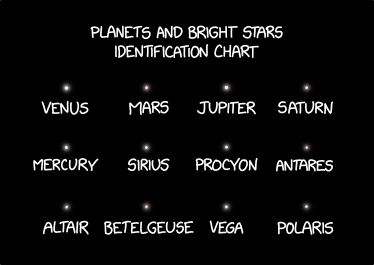
Planets and Bright Stars
An old astronomer trick for distinguishing the Sun from other stars is to take multiple photos a few minutes apart and overlay them, making the Sun stand out due to its high proper motion.
Link4 comments | Reply
[syndicated profile] schneier_no_tracking_feed Fri 2026-03-13 11:04
Academia and the “AI Brain Drain”

Posted by Bruce Schneier

In 2025, Google, Amazon, Microsoft and Meta collectively spent US$380 billion on building artificial-intelligence tools. That number is expected to surge still higher this year, to $650 billion, to fund the building of physical infrastructure, such as data centers (see go.nature.com/3lzf79q). Moreover, these firms are spending lavishly on one particular segment: top technical talent.

Meta reportedly offered a single AI researcher, who had cofounded a start-up firm focused on training AI agents to use computers, a compensation package of $250 million over four years (see go.nature.com/4qznsq1). Technology firms are also spending billions on “reverse-acquihires”—poaching the star staff members of start-ups without acquiring the companies themselves. Eyeing these generous payouts, technical experts earning more modest salaries might well reconsider their career choices.

Academia is already losing out. Since the launch of ChatGPT in 2022, concerns have grown in academia about an “AI brain drain.” Studies point to a sharp rise in university machine-learning and AI researchers moving to industry roles. A 2025 paper reported that this was especially true for young, highly cited scholars: researchers who were about five years into their careers and whose work ranked among the most cited were 100 times more likely to move to industry the following year than were ten-year veterans whose work received an average number of citations, according to a model based on data from nearly seven million papers.1

This outflow threatens the distinct roles of academic research in the scientific enterprise: innovation driven by curiosity rather than profit, as well as providing independent critique and ethical scrutiny. The fixation of “big tech” firms on skimming the very top talent also risks eroding the idea of science as a collaborative endeavor, in which teams—not individuals—do the most consequential work.

Here, we explore the broader implications for science and suggest alternative visions of the future.

Astronomical salaries for AI talent buy into a legend as old as the software industry: the 10x engineer. This is someone who is supposedly capable of ten times the impact of their peers. Why hire and manage an entire group of scientists or software engineers when one genius—or an AI agent—can outperform them?

That proposition is increasingly attractive to tech firms that are betting that a large number of entry-level and even mid-level engineering jobs will be replaced by AI. It’s no coincidence that Google’s Gemini 3 Pro AI model was launched with boasts of “PhD-level reasoning,” a marketing strategy that is appealing to executives seeking to replace people with AI.

But the lone-genius narrative is increasingly out of step with reality. Research backs up a fundamental truth: science is a team sport. A large-scale study of scientific publishing from 1900 to 2011 found that papers produced by larger collaborations consistently have greater impact than do those of smaller teams, even after accounting for self-citation.2 Analyses of the most highly cited scientists show a similar pattern: their highest-impact works tend to be those papers with many authors.3 A 2020 study of Nobel laureates reinforces this trend, revealing that—much like the wider scientific community—the average size of the teams that they publish with has steadily increased over time as scientific problems increase in scope and complexity.4

From the detection of gravitational waves, which are ripples in space-time caused by massive cosmic events, to CRISPR-based gene editing, a precise method for cutting and modifying DNA, to recent AI breakthroughs in protein-structure prediction, the most consequential advances in modern science have been collective achievements. Although these successes are often associated with prominent individuals—senior scientists, Nobel laureates, patent holders—the work itself was driven by teams ranging from dozens to thousands of people and was built on decades of open science: shared data, methods, software and accumulated insight.

Building strong institutions is a much more effective use of resources than is betting on any single individual. Examples demonstrating this include the LIGO Scientific Collaboration, the global team that first detected gravitational waves; the Broad Institute of MIT and Harvard in Cambridge, Massachusetts, a leading genomics and biomedical-research center behind many CRISPR advances; and even for-profit laboratories such as Google DeepMind in London, which drove advances in protein-structure prediction with its AlphaFold tool. If the aim of the tech giants and other AI firms that are spending lavishly on elite talent is to accelerate scientific progress, the current strategy is misguided.

By contrast, well-designed institutions amplify individual ability, sustain productivity beyond any one person’s career and endure long after any single contributor is gone.

Equally important, effective institutions distribute power in beneficial ways. Rather than vesting decision-making authority in the hands of one person, they have mechanisms for sharing control. Allocation committees decide how resources are used, scientific advisory boards set collective research priorities, and peer review determines which ideas enter the scientific record.

And although the term “innovation by committee” might sound disparaging, such an approach is crucial to make the scientific enterprise act in concert with the diverse needs of the broader public. This is especially true in science, which continues to suffer from pervasive inequalities across gender, race and socio-economic and cultural differences.5

Need for alternative vision

This is why scientists, academics and policymakers should pay more attention to how AI research is organized and led, especially as the technology becomes essential across scientific disciplines. Used well, AI can support a more equitable scientific enterprise by empowering junior researchers who currently have access to few resources.

Instead, some of today’s wealthiest scientific institutions might think that they can deploy the same strategies as the tech industry uses and compete for top talent on financial terms—perhaps by getting funding from the same billionaires who back big tech. Indeed, wage inequality has been steadily growing within academia for decades.6 But this is not a path that science should follow.

The ideal model for science is a broad, diverse ecosystem in which researchers can thrive at every level. Here are three strategies that universities and mission-driven labs should adopt instead of engaging in a compensation arms race.

First, universities and institutions should stay committed to the public interest. An excellent example of this approach can be found in Switzerland, where several institutions are coordinating to build AI as a public good rather than a private asset. Researchers at the Swiss Federal Institute of Technology in Lausanne (EPFL) and the Swiss Federal Institute of Technology (ETH) in Zurich, working with the Swiss National Supercomputing Centre, have built Apertus, a freely available large language model. Unlike the controversially-labelled “open source” models built by commercial labs—such as Meta’s LLaMa, which has been criticized for not complying with the open-source definition (see go.nature.com/3o56zd5)—Apertus is not only open in its source code and its weights (meaning its core parameters), but also in its data and development process. Crucially, Apertus is not designed to compete with “frontier” AI labs pursuing superintelligence at enormous cost and with little regard for data ownership. Instead, it adopts a more modest and sustainable goal: to make AI trustworthy for use in industry and public administration, strictly adhering to data-licensing restrictions and including local European languages.7

Principal investigators (PIs) at other institutions globally should follow this path, aligning public funding agencies and public institutions to produce a more sustainable alternative to corporate AI.

Second, universities should bolster networks of researchers from the undergraduate to senior-professor levels—not only because they make for effective innovation teams, but also because they serve a purpose beyond next quarter’s profits. The scientific enterprise galvanizes its members at all levels to contribute to the same projects, the same journals and the same open, international scientific literature—to perpetuate itself across generations and to distribute its impact throughout society.

Universities should take precisely the opposite hiring strategy to that of the big tech firms. Instead of lavishing top dollar on a select few researchers, they should equitably distribute salaries. They should raise graduate-student stipends and postdoc salaries and limit the growth of pay for high-profile PIs.

Third, universities should show that they can offer more than just financial benefits: they must offer distinctive intellectual and civic rewards. Although money is unquestionably a motivator, researchers also value intellectual freedom and the recognition of their work. Studies show that research roles in industry that allow publication attract talent at salaries roughly 20% lower than comparable positions that prohibit it (see go.nature.com/4cbjxzu).

Beyond the intellectual recognition of publications and citation counts, universities should recognize and reward the production of public goods. The tenure and promotion process at universities should reward academics who supply expertise to local and national governments, who communicate with and engage the public in research, who publish and maintain open-source software for public use and who provide services for non-profit groups.

Furthermore, institutions should demonstrate that they will defend the intellectual freedom of their researchers and shield them from corporate or political interference. In the United States today, we see a striking juxtaposition between big tech firms, which curry favour with the administration of US President Donald Trump to win regulatory and trade benefits, and higher-education institutions, which suffer massive losses of federal funding and threats of investigation and sanction. Unlike big tech firms, universities should invest in enquiry that challenges authority.

We urge leaders of scientific institutions to reject the growing pay inequality rampant in the upper echelons of AI research. Instead, they should compete for talent on a different dimension: the integrity of their missions and the equitableness of their institutions. These institutions should focus on building sustainable organizations with diverse staff members, rather than bestowing a bounty on science’s 1%.

References

  1. Jurowetzki, R., Hain, D. S., Wirtz, K. & Bianchini, S. AI Soc. 40, 4145–4152 (2025).
  2. Larivière, V., Gingras, Y., Sugimoto, C. R. & Tsou, A. J. Assoc. Inf. Sci. Technol. 66, 1323–1332 (2015).
  3. Aksnes, D. W. & Aagaard, K. J. Data Inf. Sci. 6, 41–66 (2021).
  4. Li, J., Yin, Y., Fortunato, S. & Wang, D. J. R. Soc. Interface 17, 20200135 (2020).
  5. Graves, J. L. Jr, Kearney, M., Barabino, G. & Malcom, S. Proc. Natl Acad. Sci. USA 119, e2117831119 (2022).
  6. Lok, C. Nature 537, 471–473 (2016).
  7. Project Apertus. Preprint at arXiv https://doi.org/10.48550/arXiv.2509.14233 (2025).

This essay was written with Nathan E. Sanders, and originally appeared in Nature.

LinkReply
[personal profile] andrewducker Fri 2026-03-13 12:00
Interesting Links for 13-03-2026
Link6 comments | Reply
navigation
[ viewing | 40 entries back ]
[ go | earlier/later ]