|
|
|
|
|
|
Books finished in 2026, mid April edition Finished a bunch more books since last month, so time for another update. ( earlier books )- Insomniacs After School volume 8 (manga) by Makoto Ojiro
- Shakespeare: The World as a Stage by Bill Bryson
- The Book of Life (Discovery of Witches book 3) by Deborah Harkness
- A Hat Full of Sky (Tiffany Aching book 2) by Terry Pratchett
- Bill Oddie's Little Black Bird Book by Bill Oddie
- Echolands: A Journey in Search of Boudica by Duncan Mackay
Continuing to enjoy Insomniacs After School manga, though volume 8 felt more of a filler volume than usual. The story continues to delight though, as do the lead characters. Good art too. Bill Bryson's Shakespeare biography is very compact and concise, but well done, and covers the key issues. Also suitably analytical about the evidence and different perspectives. Recommended. I reread the third Discovery of Witches book, a couple of years after rereading the second. The third book is by far my least favourite, with too much gratuitous violence, and also a rambling plot that needed tightening up. But it does provide a good resolution to the opening trilogy. A Hat Full of Sky by Terry Pratchett was another reread, as I work my way through the Witches subset of Discworld books. Tiffany is delightful, and here is combined with Granny Weatherwax plus the Nac Mac Feegles. Solidly 5/5, though it's not my absolute favourite Tiffany book. Bill Oddie's Little Black Bird Book was recommended to me by a birding friend, who knew it would give me an insight into the psychology of birders like Martin. Excellent stuff, though it was originally written back in 1980, and much is very dated now in terms of how birders operate. But still insightful, and ever so amusing. I read lots of bits out loud to Martin. Duncan Mackay's Echolands book about Boudica is a voyage of discovery, digging into her story and the landscapes in which the story unfolded. On the downside I struggled an awful lot with the numerous descriptions of places and landscape. I probably have aphantasia from my neurological disease, and it's worsened over the years as the disease has progressed further. I couldn't picture enough what was being described, though I think the written descriptions were fair. I was also frustrated by footnotes in the Kindle version not being hot linked, so pretty useless in that format. But it was an evocative read, and the discussion of the archaeological evidence was gripping. |
| | |
|
|
|
|
|
Long time I e-mailed the HR inbox with a question at work this morning, and the response I got was a name I recognized asking when she could call me to chat through the answer. It was the name I recognized from being cool about me being trans when I started this job.
I didn't think she'd recognize me, but as soon as we got on the call she said "Long time no see!" My smile, which felt both surprised and a little shy in response, hopefully gave her a good look at all the facial hair I didn't have last time we talked -- I hadn't even started testosterone yet.
|
| | |
|
|
|
|
Mudlarking 103 - Farewell to Custom House Lower Stairs Custom House Lower Stairs has been my lunchtime haunt, when the tides are amenable, so I had one last session there. There were a few tourists wandering about and the tide was not low enough to be able to get underneath the wharf, even at low tide. Finds included: White horse distillery bottle base A piece of glass with a curious shape A squashed pipe A black thing with green circles, which may be from a fire bucket.   (You need a permit to search or mudlark on the Thames foreshore.) |
| | |
|
|
|
|
Nekropolis, by Maureen McHugh 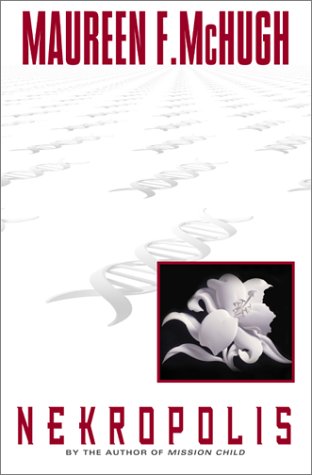 In a future Morocco, a young woman named Hariba with no prospects has herself jessed, a process which renders her loyal to whoever buys her, and sells herself as an indentured servant to a wealthy household. There she meets Akhmim, a harni - a genetically engineered human designed to be a perfect lover or companion. Hariba falls in love with him and runs away with him, but because she's jessed, she becomes extremely sick due to defying her loyalty implant. Up until this point, the book had a compelling atmosphere a bit reminiscent of The Handmaid's Tale in that it explored the daily life of people living with very little agency in the home of someone who owns them. But once Hariba gets sick, she becomes completely sidelined from the story and basically lies in bed suffering for the entire middle part of the book, while the POV switches from Hariba and Akhmim to first her mother, then her friend - neither of whom are very interesting. ( Read more... )This is a well-written book with interesting issues that sags a lot in the middle portion when Hariba basically drops out of the story, and ends in a note of depression and gloom. Though I didn't love this book, I'm sorry that McHugh doesn't seem to be writing novels anymore as I did quite like China Mountain Zhang and Mission Child. |
| | |
|
|
|
|
I used to do this sort of thing first thing in the morning and go about my day On the other hand, I am thinking of the times when I was dealing with a fairly professional set of meedja people either coming with their gear to interview me in my Former Workplace, or else having me in a studio nicely set up for the purpose.
Not recording a podcast from my own front room on my own computer and having to set up my own headphones and mike and feeling that the instructions about Settings could pertain a little closer to what I find there....
And adjust the curtains so that there was not a glare off the portrait photo of Dame Rebecca and all that sort of thing.
- the fact that the connection to Headphones was no longer saying Headphones might have been a clue that all was not entirely as it should be -
So anyway, when I got connected there was total silence and had to do a certain amount of jiggling around and changing the settings and anyway, did finally get to the stage where I was both audible and able to hear everyone else.
Though when I spoke the effect was, roughly speaking, of a 45 rpm single being played at 33 rpm, no, I have no idea why, they were fairly hopeful this could be sorted in editing.
The actual discussion went okay I think - other person who was there to be Nexpert is old(ish) mate who has just writ a book of relevance which cites me quite a bit.
But lo and behold, had a subsequent email from them expressing concern over the slurring issue in case it was Health Thing and should I see my GP, which was thoughtful, but really, it was TECHNOLOGICAL ISSUE. (I did not respond, hey, your image was looking really blurry and faint, are you feeling well? because I assumed that was their camera.)
Am feeling mildly knackered now, unlike the days when I would jaunt down to Broadcasting House, do my chat on Woman's Hour, and then go and do my normal day's work.
Of course, I was Younger then. |
| | |
|
|
|
|
|
The Big Idea: Cameron Johnston Posted by Athena Scalzi https://whatever.scalzi.com/2026/04/16/the-big-idea-cameron-johnston-2/ https://whatever.scalzi.com/?p=60229 
The Scientific Method is immensely helpful, but so is literal magic. Would the power of science prove to be more powerful than the power of wizardry? It’s tough to say, but author Cameron Johnston certainly speculates on the idea in the Big Idea for his newest novel, First Mage on the Moon. Read on to see how the Space Race might’ve happened with the help of a wizard’s staff.
CAMERON JOHNSTON:
For a bunch of wise folk that meddle with reality and break the rules of standard physics on a regular basis, wizards and mages in fantasy media seem a remarkably uncurious lot. Sometimes magic users are far more interested in other dimensions and eldritch creatures than in the mortal world they themselves inhabit. How many of them look up at the stars and wonder what they are, or gaze at the moon and ponder what that shining silver disc really is…and how they might get there?
First Mage On The Moon was born from a single Big Idea (OK, OK…the idle thought of a fantasy-fan): Without science, how would wizards describe gravity? Inevitably, that grew arms and legs and tentacles and thingamabobs into: What would they make of outer space? How would they breathe in a spacecraft when they don’t even know what oxygen is or why air ‘goes bad’. What about aerodynamics? and a whole host of other questions I didn’t then have answers for. When you only have a magical understanding of the world and the closest thing to science is the semi-mystical and secretive practice of alchemy, well, then things get complicated if you want to build something to visit the moon. Magic is not going to solve everything if you fly straight up and try to hit a moving object like the moon, and don’t factor in the calculations for orbits, gravity… or indeed the speed/friction of re-entry.
Science is an amazing and collaborative process and Earth’s 20th-century Space Race was a species-defining moment, but what if that happened in a fantasy world of mages, golems, vat-grown killing machines and grinding warfare. What if a group of downtrodden mages sick of building weapons of mass destruction for their oligarch overlords decided to go rogue and divert war materials into building a vessel to go to the moon, the home of their gods, and ask for divine intervention in stopping the war. When you have no culture of shared science, where do you even begin?
All those thoughts and ideas stewed away in the back of my brain while I was writing my previous novel, The Last Shield. As all authors know, there comes a stage of writing a book when your brain goes “Ooh, look at the shiny new thing!” Very helpful, brain, coming up with magical rocket ships when I’m trying to write a book set in a fantasy version of the Scottish Bronze Age – thanks very much! That idea of wizard-science and magical engineering lodged there, immovable, and my next book just had to become First Mage On The Moon. Which was handy, as I was contracted to write another standalone novel.
While the US/USSR Space Race and modern science of our very own Earth was inevitably a huge influence on my novel, so too were the theories and writing of its ancient thinkers. Around 500 BCE, Pythagoras proposed a spherical world, and Aristotle later wrote several arguments for the same theory, such as ships sailing over the horizon disappearing hull-first and different constellations being visible at different latitudes (all of which may have given the Phoenician sailors and navigators certain thoughts too). And then comes Eratosthenes, Chief Librarian of Alexandria, and a very smart dude who was able to calculate the circumference of Earth by using two sticks in two locations and comparing the angles of their shadows. If those ancient Earth scholars could calculate such things, then surely fantasy mages, with all the magic at their disposal, could do more than fling fireballs at each other. There had to be some among them with the desire to explore beyond the bounds of myth and magic, gods and monsters, and given the opportunity to work with like-minds to build something that has never been done before, they would surely take it…despite the risks.
Found family, magical engineering, and mad ideas of actual science in a magical world all came together to form First Mage On The Moon. As much as I love my morally grey characters in realms of swords and sorcery, it was deeply satisfying to write something that little bit different, a hopeful story about human ingenuity in an increasingly fraught world.
First Mage On The Moon: Amazon|Amazon UK|Barnes & Noble|Bookshop|Powell’s|Waterstones
Author socials: Website|Bluesky|Facebook|Instagram https://whatever.scalzi.com/2026/04/16/the-big-idea-cameron-johnston-2/ https://whatever.scalzi.com/?p=60229 |
| | |
|
|
|
|
I Met A Person I Thought Didn't Exist. I did, in fact, meet someone that I thought did not exist, except, perhaps, as a thought experiment. Fortunately for me, they were quite willing to explain why they had done what they did. Unfortunately, I met them in a work context, and therefore, my ability to both cut off the conversaion and to provide blistering counterpoint commentary were both limited. (Honestly, it was probably a good thing that this happened at work, so that my professional responsibilities kept me from delivering deeply personal and acidic responses.) So, a person with an Irish accent explained to me, as part of a shaggy dog story involving donating a book by Bill Clinton to our Friends of the Library sale, that she still felt bad that she was giving away a book by a Clinton that she hadn't actually fullly read. That she was otherwise a staunch Democrat, and had never wanted to vote for a Republican. That she was convinced that the current President was either evil, non compos mentis, or possibly both. The first possible sign was that she had been uncomfortable with the scandalous behavior of Bill Clinton. I mentioned that the starting wars in the Middle East should have gotten more media coverage, especially compared to the coverage his indiscretions in the White House received. And when she asked what I thought about the current administrator, I said, in my best diplomatic tones, "I'm not allowed to have an opinion about that while I'm on the clock." Which is entirely true, and also the strongest signal I have in my toolbox to deploy of "You don't have to convince me that this person and his supporters with power are doing great evil everywhere." ( She turns out to be a member of those who believed in the thrust of the odious lies told about where Kamala Harris's priorities were on queer people. )I hadn't thought these people existed for the second time around, based on how things went for this administrator the first time around, but thanks to being white and looking like someone who would be willing to assuage her guilt, or at least not berate her for it, I got the story, and more confirmation that yes, indeed, ther are still too many people who vote their -isms over anything else they might consider a calid reason for voting. I realize this is not new to a lot of people who experience those -isms in more direct manners, and that my privilege lets me believe that people wouldn't do that, even in the face of large amounts of evidence to the contrary. In this particular case, though, I had thought this administrator had been sufficiently clear that people knew what they were voting for, and anyone who did it was clearly a member of the Leopards Eating People's Faces Party. There's no heroic conclusion to this story. No minds were changed, and the person only disengaged because the eide shuttle the county operates had arrived for her. I was reminded that "Democrat" and "progressive" are two very different things, as is "Democrat" and "decent human being.' And that none of us are immune to propaganda, especially the kind of propaganda that preys upon our beliefs about who young people are, and our deeply-held convictions of how the universe is ordered and arranged. It was a sobering experience. I sincerely hope that this person is working against the administrator she voted for at this point, and that she will not make the same mistake for the next person who comes out claiming to be working on behalf of children against the evil educators and trans people. But I can't say for certain, at all, about that, because I keep seeing these kinds of "keep children off social media by forcing everyone to give up identification of themselves if they want to be treated as an adult" bills showing up, and programs that comply with those bills. In this era, it's not hard to imagine there is someone in conversation with their god, earnestly negotiating on behalf of humans against our destruction and annihiiation. "If there are fifty just people in this world," this person is saying, "will you spare it from your wrath?" Not because they necessarily are sure there are fifty just people in the world, but because they need to set a starting point within spitting distance of where they really want to be. And if the god will grant fifty, then surely forty-five isn't such a stretch, right? Forty? Thirty-five? Thirty? Twenty? Ten? Five? If there are only five just people in the world, surely a being that created the world and peopled it and put all that effort into it would be willing to spare the rest of us for the sake of those five? It wouldn't be fair to those five just people to have their existences cut short because of the follies of the rest of us, would it? It wouldn't be just, right? Each time our negotiator lowers the bar, they're truly concerned that they've pushed it one spot too many, and that the god will call the whole thing off and destroy us anyway. But, so far, they seem to be winning their negotiation. So it's our job to be one of those five people that this negotiator desperately hopes exists. (Because this negotiator isn't saying "five just people who are of my religion," they're saying "five just people.") I am not sure I am one of those five just people. I'm not sure I will ever be one of those five just people, but my ethics demand the relationships I have with other people should celebrate their virtues and victories and support them in their struggles against their vices and their demons. Regardless of whether there is a god at the end who will say, "That one's mine. You've earned a rest, friend, come celebrate." That's what makes this story a warning, and a tale of horror, not because I Told You So, but because in a moment of following fear rather than solidarity, so many more people than the person casting their vote are suffering. We can always hope that wisdom will prevail in those moments, but it is never a surety, and so we are left with the hope that there are still five just people left in the world, and someone is negotiating to get the number down that low so we can all stay alive for another chance to prove that we learn from our mistakes.
| [ | Current Mood: |
| |  contemplative contemplative | ] |
| [ | Current Music: |
| | MEUTE - The Coup | ] | |
| | |
|
|
|
|
Opera Atelier's Pelléas et Mélisande doesn't quite hit the target |
| | |
|
|
|
|
|
|
|
Reading/Listening On Radio 4 Extra the other week, I heard a repeat of an edition of Good Reads in which Harriet Gilbert made Patrick Grant read Penelope Lively. Patrick Grant said his mother's book group read a lot of Penelope Lively but he hadn't ever read any and now he would go and read lots more* (Listen to your mother!). Then I saw a Penelope Lively book in a charity shop and thought I should read it. It turned out that the book in the programme was Heatwave (which I haven't read) and the one I got was Consequences. Consequences is always an ominous title but fortunately this one does not live up to the trauma of E M Delafield. The blurb and the cover make it sound terrible "privileged misfit Lorna meets the love of her life", "a penniless and bohemian artist" but "the coming war takes Matt - and with him Lorna's dreams - away" but it is lovely - and goes on through 2 more generations and then it comes full circle and made me cry. Here I admit that much of its appeal for me came from it being set near where I live. This is understandable because Penelope Lively spent a lot of her childhood with her grandparents at Golonscott House in West Somerset. Here is a piece about Penelope Lively's aunt the artist Rachel Reckitt with a picture of the house at the end. I now need to go on a Rachel Reckitt local tour.* But the book is also about odd families of choice and people making their own decisions and being a bit out of step with their times. Though it is a pity characters have to keep suddenly dying. But it is also a book that loves West Somerset. The cottage stood beside a lane. At the front, it looked out over the high hedge bank of its garden, across the lane and the sloping field beyond to a wooded valley that reached up into the Brendon Hills. Behind, fields and copses rolled away down to the Bristol Channel coastline; there was a long, thin slice of pewter sea and, on a clear day, the distant shore of Wales. Square and squat, cob and thatch, dug solid into the red Somerset earth, the small building had seen out generations of farm labourers. People had been born here, died here, had heard rumours of wars, had achieved the vote, had sweated over the same patch of landscape and stared at the same sky. Now, the place stood empty, bar the mice and the black beetles and the spiders. Empty and two pounds a month. And here is Ruth, Lorna's granddaughter: "The M4. The M5. Comfort stops at teeming motorway service stations through which flowed the August crowds. The nation was on the move and the west country was the place to which it moved.
[...]
And now the directions sent her off sharply into the hinterland. You burrowed into this landscape, she saw. The motorways rushed through it, and the A this and the B that, but as soon as you abandoned those dictatorial highways you had slipped off into another sphere. You were in the lanes, you were in narrow tunnels between high hedge banks, routes that also knew quite well what they were about and where they were going but that was their own immemorial business, and you were now in their domain. You went where they went, and that was that." Shortly after this she has to reverse for a tractor and scrapes the side of her car on a raised rock. It is the way of things. Then she gets very lost in the lanes and "horror of horrors" ends up back on the A39 again before being able to turn round. That is also the way of things. My favourite quote though in the narrow, high-hedged lanes is "here and there a glimpse through a gate of blue and green distances like the jewelled vistas in medieval painting". Something so familiar here, put into words that make you see it differently. Otherwise, the album of the current Broadway production of Chess is out. Obviously I am not going to New York to see Chess but I would really like to know what the production did with it this time. Youngest and I have been listening to the album and going "why did they put that song there" and "why is Florence singing Someone Else's Story and why is it at the end?" and Eldest keeps saying "I don't know, take it up with Jonathan from Buffy the Vampire Slayer" because Danny Strong wrote the book. He has in fact done a YouTube video about how he fixed the problems with Chess but it doesn't actually tell me what he did other than that it was very difficult to create scenes that used the existing narrative in the song lyrics to join them all up presumably in a different way? Nor does he mention the Swedish production, which did solve the problems with Chess and I would like to know if he knew about it and what he decided to do differently. This production includes "He is a Man, He is a Child" (sung by Svetlana which is presumably why Florence gets Someone Else's Story) and that originated in the first Swedish production so you would have thought so? The new overture is very good though. I liked that. I assume it hasn't had one before because often people put The Story of Chess at the start instead because it doesn't fit anywhere else unless you are trying to give the audience something to listen to while people play chess. *He also said reading it had given him an insight into what it must be like to worry about things and be introspective, which is something people close to him have struggled with. I feel probably Patrick Grant should listen to the people he knows rather than what, not believe them until someone puts it in a book? I like Patrick Grant on Sewing Bee but the inside of his head must be so different from practically everyone I know. **I would also have liked to have seen the exhibition at the museum had I known it was on and had my daughter who works for the heritage trust happened to mention it. |
| | |
|
|
|
|
No Vietnamese To Be Commemorated? Hmmm.
| [ | location |
| | Home-for-now | ] |
| [ | Current Mood: |
| |  Wary Wary | ] | |
| | |
|
|
|
There's Nothing Like a Nap With Your Bestie |
| | |
|
|
|
|
[ Books ] 'Project Hail Mary' - Andy Weir  Project Hail Mary Project Hail Mary by Andy WeirMy rating: 5 of 5 starsLoved this. Of course in describing an interstellar travel there are a few impossibilities and you have to choose which to ignore but the story here felt 'real'. Loved the possibility of friendship between beings that have so little in common -even sensorial bandwidth. We could all learn a couple of lessons from Rocky. A perhaps implausible plot with a wild take on Panspermia but it all works and you 'live' in that world for the duration of the book. Loved this book. View all my reviews |
| | |
|
|
|
|
aagyaman (16 April 2026) What are you thankful for this week?
· Photos are optional but encouraged.
· Check-ins remain open until the following week's post is up.
· Do feel free to comment on others' check-ins but don't harsh anyone else's squee.
| [ | Current Mood: |
| |  sick sick | ] | |
| | |
|
|
|
|
|
|
|
|
|
Female Leads
| [ | Current Mood: |
| |  busy busy | ] | |
| | |
|
|
|
|
Miss Manners: They invited me to brunch at their freezing mansion Greetings, everyone! I have been enjoying reading the entries and discussion in this community, and came upon this article today that I thought I'd share:~~~ Link: wapo.st/4csfhDU Dear Miss Manners: I was invited to a brunch as the only guest. The hosts live in a 6,000-square-foot mansion, of which all of the rooms could be photographed for a slick architectural magazine. Brunch was delicious, but the rub of the situation was that the house was 54 degrees in temperature, and it was 15 degrees outside. I am on blood thinners and I am very cognizant of cold. When I inquired if they were having heating issues, the reply was that the house is too expensive to warm up to 68 degrees, and that they do not like large gas bills. ( Read more... ) |
| | |
| |
![[personal profile]](https://www.dreamwidth.org/img/silk/identity/user.png)
![[syndicated profile]](https://www.dreamwidth.org/img/silk/identity/feed.png)




![[community profile]](https://www.dreamwidth.org/img/silk/identity/community.png)
